
Touchscreen Centralised Controller
Our touchscreen centralised controllers provide a unified local hub for managing VRF systems, scaling from a compact 4.3-inch screen managing up to 32 indoor units to an advanced 7-inch display controlling up to 255 units. These interfaces feature administrative “shielding” to lock out local room remotes, automated scheduling, and multi-language support. The flagship 7-inch model adds built-in temperature and humidity sensors, fire alarm integration, and dual-band Wi-Fi for remote mobile app control
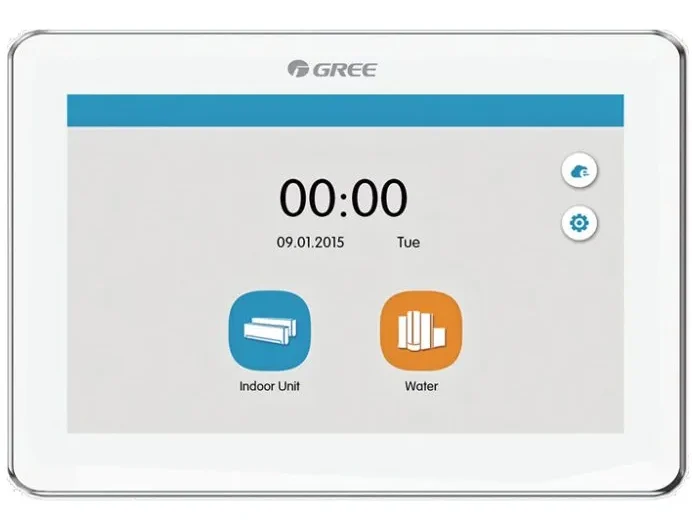
CE52-24/F(C)
Classic Centralise Controller
| Model | E Smart Zone Controller CE54-24/F(C) |
| Screen Size | 4.3 inches |
| Dimensions | 480 mm x 272 mm |
| Language Support | 5 languages include: Simplified Chinese, Traditional Chinese, English, German, and Korean |
| Max Number of Controllers | 16 |
| Max No. of Indoor Unit | 32 |
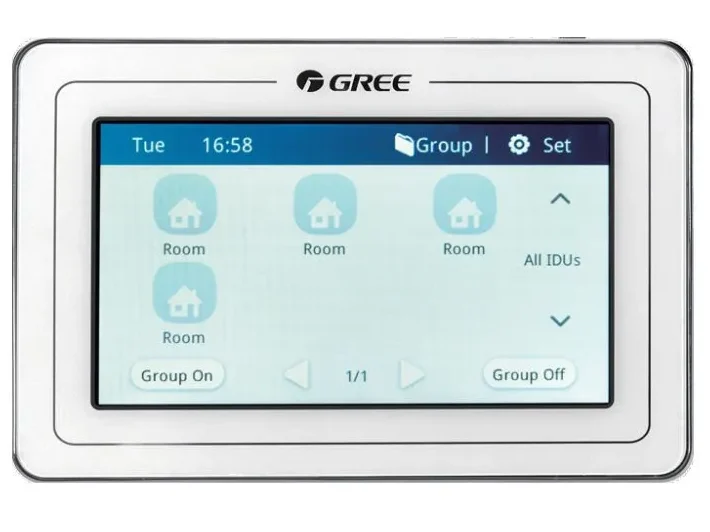
CES54-24/F(C)
E Smart Zone Controller
| Model | E Smart Zone Controller CE54-24/F(C) |
| Screen Size | 4.3 inches |
| Dimensions | 480 mm x 272 mm |
| Language Support | 5 languages include: Simplified Chinese, Traditional Chinese, English, German, and Korean |
| Max Number of Controllers | 16 |
| Max No. of Indoor Unit | 32 |
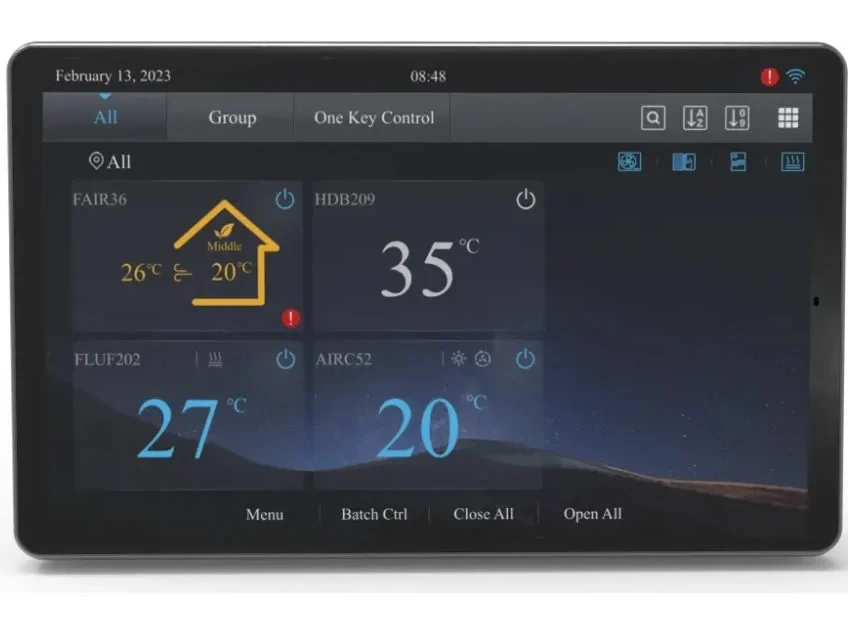
CE58-00/EF(CM)
Premium Flagship Controller
| Model | Flagship Centralsed Controller CE58-00/EF(CM) |
| Screen Size | 7 inches |
| Dimensions | 1280 mm x 800 mm |
| Language Support | 17 languages include: Simplified Chinese, Traditional Chinese, English, Spanish, Dutch, German, Italian, Portuguese, Russian, Czech, Turkish, Lithuanian, Polish, Estonian, Greek, and Hungarian |
| Max Number of Controllers | 16 |
| Max Number of Indoor Unit | 255 |
Features
Unified Multi-Unit Control
Manages and monitors multiple indoor units across various rooms and zones from a single wall-mounted touchscreen panel
System Integration
Integrates into the broader building control network alongside key-card wired controllers, remote computer management (Remote Eudemon), and tenant billing software
Linked Network Control
Connects via CAN-Bus / HBS communication networks, enabling linked control between indoor units and fresh air units (ERV) without requiring specialized shielded wiring
Essential System Settings
Provides centralized access to key operational controls, including mode selection, temperature adjustment, weekly timer scheduling, child lock, and power failure memory
Faster Servicing & Diagnostics
Simplifies daily operation and maintenance by centralizing fault alerts and operating statuses for faster service response