
How to Read an Aircon Catalogue: A Singapore HDB and Condo Owners’ Guide
TL;DR
- System type: the Combination Capacity table shows which indoor-unit combinations work. Read Total Capacity, Total Power Input and Total Running Current.
- HDB amp limit: for 30A main switch flats, it is 5A (1–2 room), 8.5A (3–5 room) and 11A (5-bedroom Executive Apartment in a converted block). Confirm with your installer.
- Cooling: read the actual BTU/h or kW figure, not the “9k” or “12k” name.
- Efficiency: use the NEA ticks (1–5). Since 1 April 2025, the minimum is 4 ticks for single-split and 5 ticks for multi-split. To know exactly, how much? Power input is used for calculation.
- Noise: Although not a regulatory limit, commonly cited WHO bedroom noise is around 30dB (A). For a quieter sleeping environment, lower the better. Outdoor units must not cause nuisance to neighbours.
- Fit: HDB compressors can only go on the aircon ledge, so check the unit’s size and weight first.
Don’t have a catalogue yet? Download the Gree catalogue and follow along with the datasheets.
The datasheet looks scary with all the numbers, and it is hard to know whom to trust at the showroom. Once you know where to look, it is quite simple.
Step 1: Which aircon system do you need?
The system tells you how many indoor units connect to one outdoor compressor. A System 2 runs two rooms, a System 3 runs three, and so on. The more indoor units you plan, the bigger the compressor, and the cooling you get in each room also changes.
Not every combination is allowed, because of technical limits. You can only see which ones work in the Combination Capacity table of the outdoor unit. For example, the Gree Charmo multi-split range goes from System 2 up to System 6 (see the Charmo range).
Here is a sample Combination Capacity table (model GWCD-MS18/O). The numbers beside each room are the cooling capacity of each indoor unit in kW.
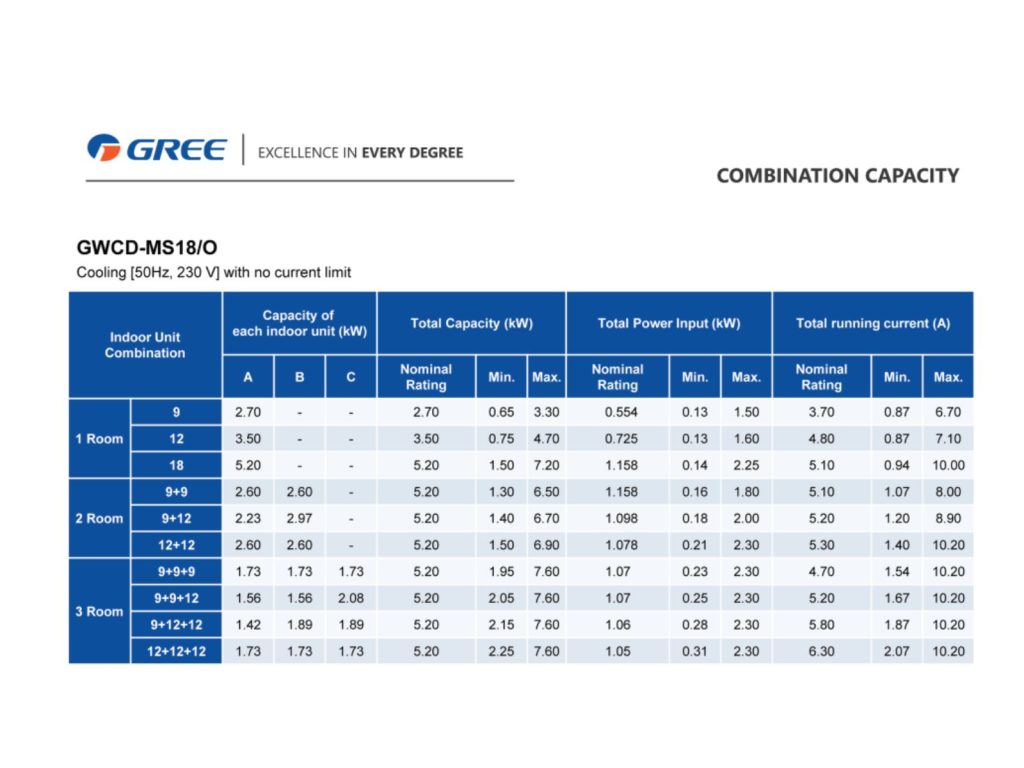
In the table, look at three columns:
- Total Capacity (kW): how much cooling you get when the units run together.
- Total Power Input (kW): how much electricity the whole system draws.
- Total Running Current (A): the current needed to run the compressor and indoor units.
Total Running Current matters most for HDB flats, which have a limit. Under HDB’s 30A main switch guidelines, the maximum total running current is 5.00A for 1- and 2-room flats, 8.50A for 3-, 4- and 5-room flats (as well as Executive Maisonette and Multi-Generation flats), and 11.00A for a 5-bedroom Executive Apartment in a converted block. Flats with a 40A main switch follow a different rule. Check the latest figures on the HDB air-conditioner installation page and our HDB aircon permits guide, and confirm with your installer before you buy.
Step 2: Which numbers on the catalogue matter?
Decide what you care about most, then read the matching number:
Your priority | What to look at | Why it matters |
Cool the room faster | Rated cooling capacity (BTU/h or kW) | Higher capacity cools the same room faster compared to a lower capacity unit. |
Lower electricity bill | Total power input, and NEA ticks | Lower power input means a lower bill for similar cooling. |
Quiet room | Indoor and outdoor sound level (dB(A)) | Lower dB(A) means less noise for you and your neighbours. |
Fits your home | Outdoor unit dimensions and weight | HDB compressors can only go on the aircon ledge. |
1. What is rated cooling capacity, and why does it matter?
Rated cooling capacity is how much heat the aircon removes, shown in BTU/h or kW. If you want a room to cool quickly, compare the capacity of each indoor unit. Do not go by the “9k” or “12k” name alone. Read the actual figure on the datasheet. For example, the Gree Charmo 9,000 BTU class indoor unit is rated at 9,212 BTU/h (2.70 kW) (Gree Charmo specifications).
For a System 2 or above, check two numbers: the total capacity (cooling when all indoor units are on) and the capacity of each indoor unit (which room gets cooler). Not sure what size you need? See our BTU guide for HDB bedrooms.
2. How do I check if an aircon is energy-efficient?
Look at the NEA energy label first. It shows 1 to 5 ticks (1 is Low, 5 is Excellent), plus the yearly energy use in kWh and estimated yearly cost. NEA bases these figures on 27 cents per kWh, 8 hours of use and 16 hours of standby a day, so your actual bill will differ (NEA energy label guide). Since 1 April 2025, NEA’s minimum standard is 4 ticks for single-split and 5 ticks for multi-split aircons (NEA MEPS).
Then read two numbers on the datasheet:
- Total Power Input (kW): the power used by your indoor units and compressor. Multiply by your hours of use and your tariff to estimate your bill. Our aircon electricity cost guide shows how.
- Total Running Current (A): the current needed to run the system. This is also what you check against your HDB electrical limit.
3. How loud should an aircon be?
Check the sound level in dB(A) for both the indoor and outdoor unit. Lower is quieter.
- Indoor unit: a constant hum is distracting when you talk, watch TV or sleep. The WHO bedroom guideline, as cited in a 2016 peer-reviewed sleep study in Noise & Health, is an average of 30 dB(A) or lower. The same paper notes that noise at around 30–40 dB(A) can cause awakenings. For reference, the Gree Charmo 9,000 BTU indoor unit is rated at 30 dB(A) at low fan speed and 39 dB(A) at high (Charmo specifications).
- Outdoor unit: it can disturb your neighbours. HDB requires rubber padding under the condensing unit, and says units must not cause vibration or nuisance. If neighbours complain, HDB can ask you to stop using or remove the unit. Residents are also encouraged to keep noise down during quiet hours, 10.30pm to 7am (MND noise infosheet).
4. Will the compressor fit on my HDB aircon ledge?
HDB compressors can only go on the aircon ledge. HDB says the ledge is strictly for the air-con condensing unit only, and units cannot be placed along the common corridor. So check the outdoor unit’s dimensions and weight on the datasheet against your ledge before ordering. For flats with a 30A main switch, HDB sets a maximum condensing unit weight of 80kg.
Condo? Your management corporation (MCST) may have its own rules on where the outdoor unit goes, so check with them first.
Ready to choose your aircon?
Download the Gree catalogue to compare models and read the datasheets at your own time.
Want to go through it with someone? Bring the datasheet and your floor plan, and we will go through the Combination Capacity table with you: which system fits your flat, whether it stays within your HDB electrical limit, and what your running cost will look like.
Book a free consultation with Gree Singapore and we will help you pick the right system for your home.